

Mission Statement
Founded in 1975 by Evalyn Pierpoint Gill, International Poetry Review is dedicated to the idea that the world becomes a better place when we listen to the voices of writers working in a variety of languages. The journal publishes works written by global contemporary writers in their own languages accompanied by facing English translations.
a note to our readers
After many years of publication, International Poetry Review will pause publication beginning in Fall 2026. The journal will not publish issues in 2027. At this time, we do not yet know whether publication will resume in 2028.
For decades, International Poetry Review has offered a place where poems, translations, and critical voices from around the world could meet. Each issue has been shaped by the work of poets, translators, scholars, and readers who believed in the quiet but enduring power of poetry to cross languages, histories, and borders.
We are deeply grateful to everyone who has contributed to the life of this journal and to those who have read and supported it over the years. Thank you for being part of this shared conversation in poetry.
INTERNATIONAL POETRY REVIEW 49.2026:
the work of staying

The poems gathered in this issue of International Poetry Review 49.2026 confront a struggle over meaning: who assigns it and what meaning is imposed on experience. These diverse voices speak of memory, loss, and endurance, insisting on the right to speak plainly when language proves unstable or inadequate. They evoke the fleeting textures of childhood, the rituals of daily life, the scars of survival, and the quiet persistence of labor, grief, and love. What unites them is not a single message but a shared refusal to simplify experience. At a moment when language is often used to obscure rather than reveal, these poems preserve the fragile act of attention, reminding us that to listen closely and to name what is lived remains a profound form of care.
INTERNATIONAL POETRY REVIEW 48.2025:
Fragments of becoming: poetry beyond duality
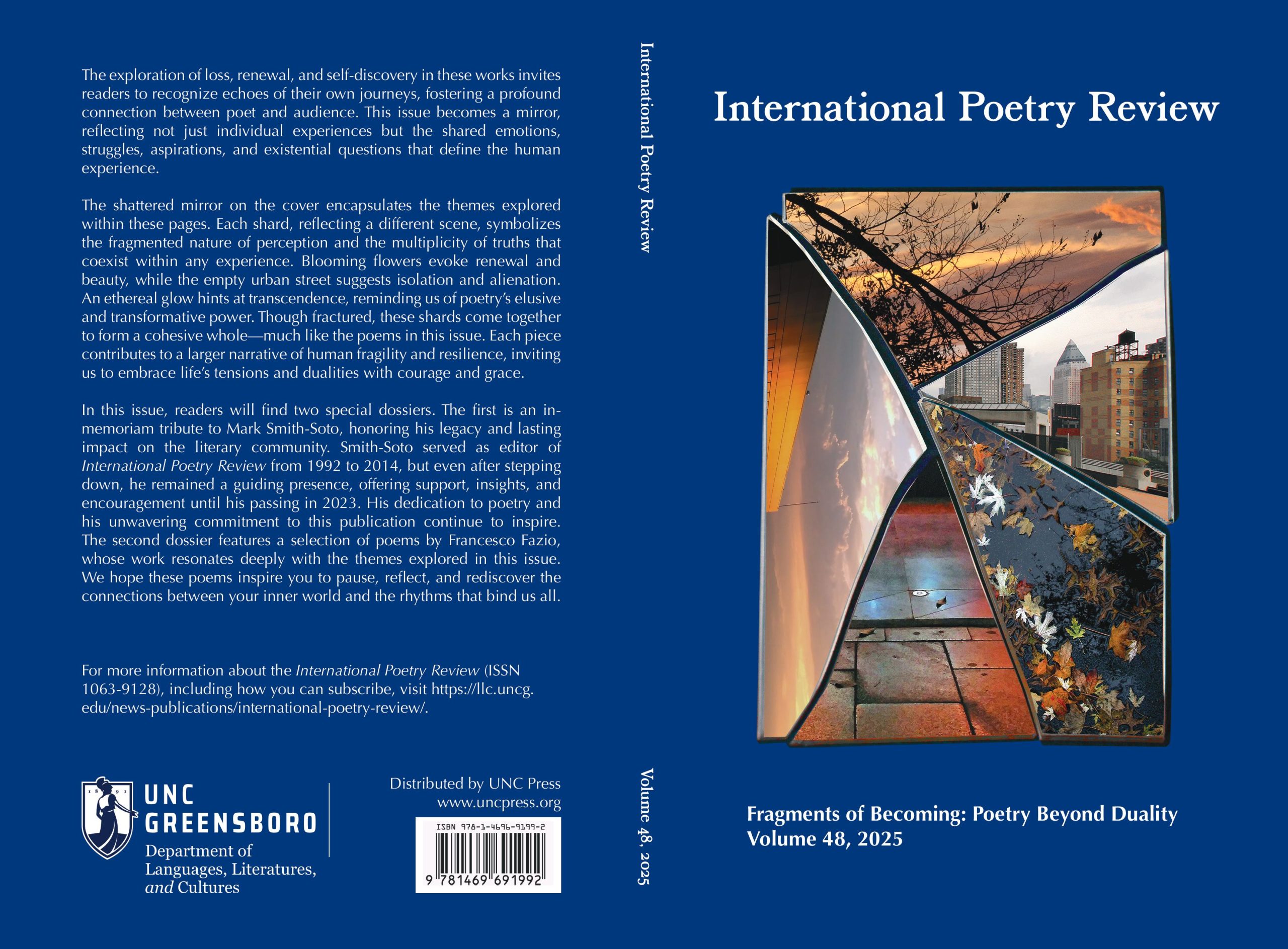
The exploration of loss, renewal, and self-discovery in these works invites readers to recognize echoes of their own journeys, fostering a profound connection between poet and audience. This issue becomes a mirror, reflecting not just individual experiences but the shared emotions, struggles, aspirations, and existential questions that define the human experience.
The shattered mirror on the cover encapsulates the themes explored within these pages. Each shard, reflecting a different scene, symbolizes the fragmented nature of perception and the multiplicity of truths that coexist within any experience. Blooming flowers evoke renewal and beauty, while the empty urban street suggests isolation and alienation. An ethereal glow hints at transcendence, reminding us of poetry’s elusive and transformative power. Though fractured, these shards come together to form a cohesive whole—much like the poems in this issue. Each piece contributes to a larger narrative of human fragility and resilience, inviting us to embrace life’s tensions and dualities with courage and grace.
In this issue, readers will find two special dossiers. The first is an in-memoriam tribute to Mark Smith-Soto, honoring his legacy and lasting impact on the literary community. Smith-Soto served as editor of International Poetry Review from 1992 to 2014, but even after stepping down, he remained a guiding presence, offering support, insights, and encouragement until his passing in 2023. His dedication to poetry and his unwavering commitment to this publication continue to inspire. The second dossier features a selection of poems by Francesco Fazio, whose work resonates deeply with the themes explored in this issue. We hope these poems inspire you to pause, reflect, and rediscover the connections between your inner world and the rhythms that bind us all.
INTERNATIONAL POETRY REVIEW 47.2024:
THE ARAB SPRING
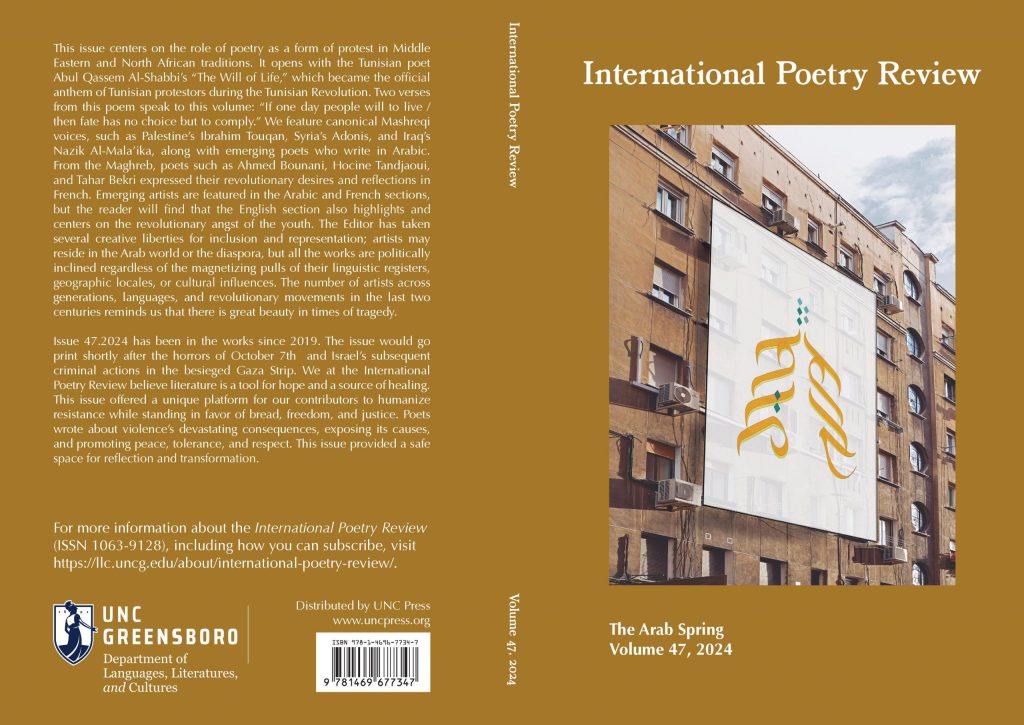
This issue centers on the role of poetry as a form of protest in Middle Eastern and North African traditions. It opens with the Tunisian poet Abul Qassem Al-Shabbi’s “The Will of Life,” which became the official anthem of Tunisian protestors during the Tunisian Revolution. Two verses from this poem speak to this volume: “If one day people will to live / then fate has no choice but to comply.” We feature canonical Mashreqi voices, such as Palestine’s Ibrahim Touqan, Syria’s Adonis, and Iraq’s Nazik Al-Mala’ika, along with emerging poets who write in Arabic. From the Maghreb, poets such as Ahmed Bouanani, Hocine Tandjaoui, and Tahar Bekri expressed their revolutionary desires and reflections in French. Emerging artists are featured in the Arabic and French sections, but the reader will find that the English section also highlights and centers on the revolutionary angst of the youth. The Editor has taken several creative liberties for inclusion and representation; artists may reside in the Arab world or the diaspora, but all the works are politically inclined regardless of the magnetizing pulls of their linguistic registers, geographic locales, or cultural influences. The number of artists across generations, languages, and revolutionary movements in the last two centuries reminds us that there is great beauty in times of tragedy.
Issue 47.2024 has been in the works since 2019. The issue would go print shortly after the horrors of October 7th and Israel’s subsequent criminal actions in the besieged Gaza Strip. We at the International Poetry Review believe literature is a tool for hope and a source of healing. This issue offered a unique platform for our contributors to humanize resistance while standing in favor of bread, freedom, and justice. Poets wrote about violence’s devastating consequences, exposing its causes, and promoting peace, tolerance, and respect. This issue provided a safe space for reflection and transformation.
INTERNATIONAL POETRY REVIEW 46.2023:
TRANSITIONS
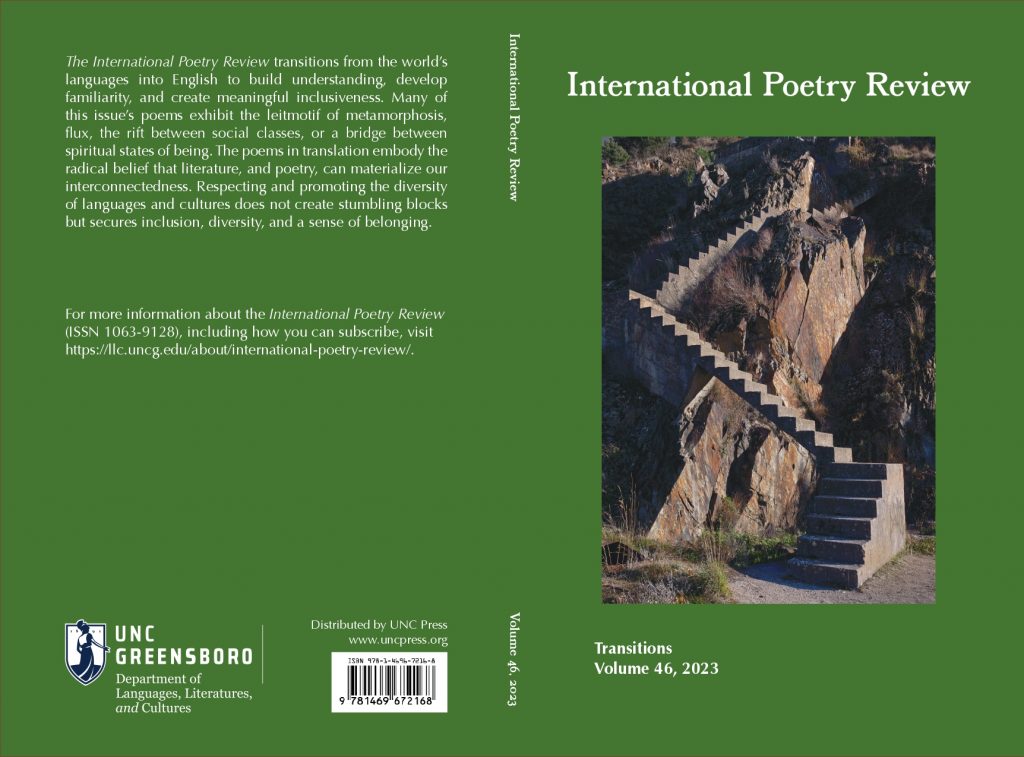
Since 1973, through the art of translation and the visible relationship between the original and English-language versions, each issue of the International Poetry Review has been a form of transit. This vehicle carries the creativity of people speaking various languages into English to build understanding, develop familiarity, and create meaningful inclusiveness. Many of the poems in IPR 46.2023 exhibit the leitmotif of metamorphosis, flux, the rift between social classes, or a bridge between spiritual states of being.
International Poetry Review 45.2022:
In English Translation
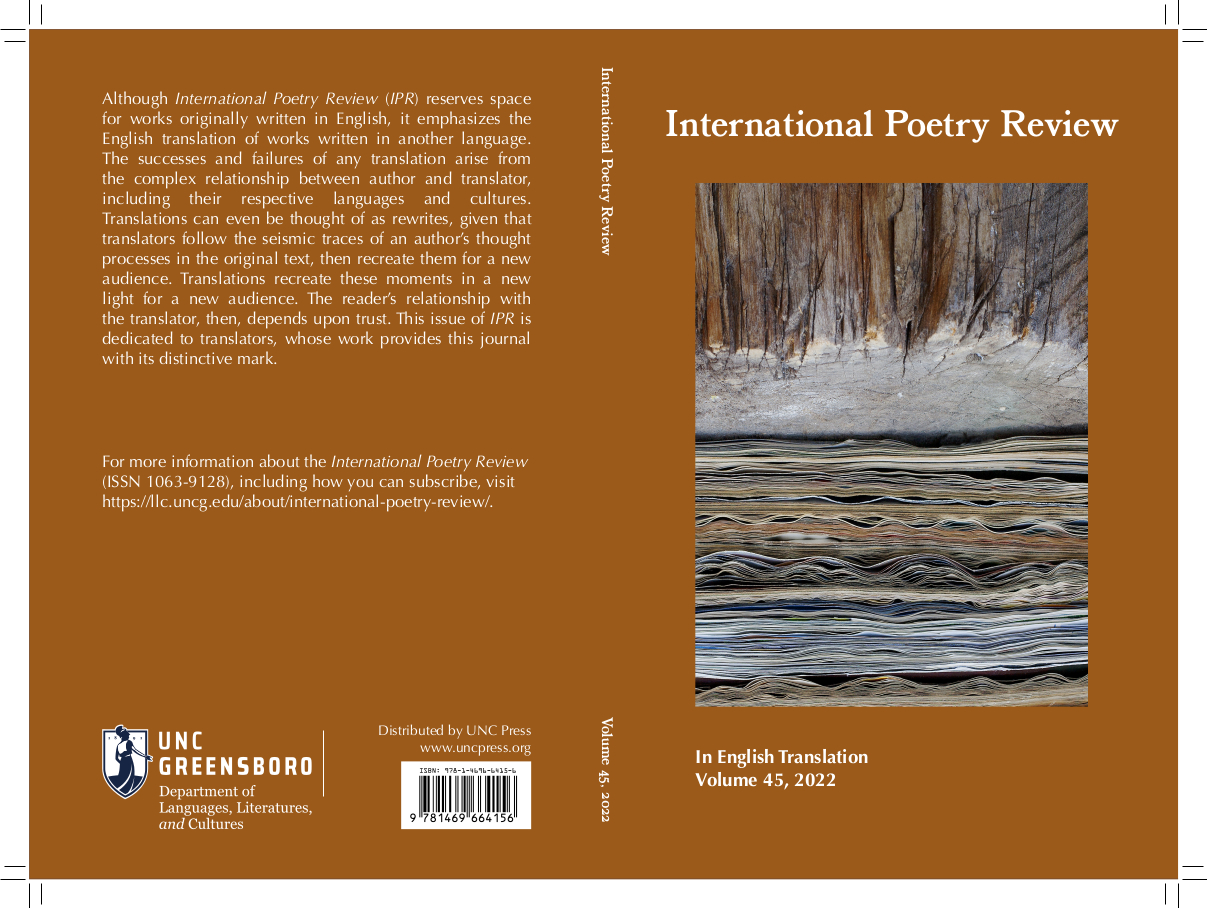
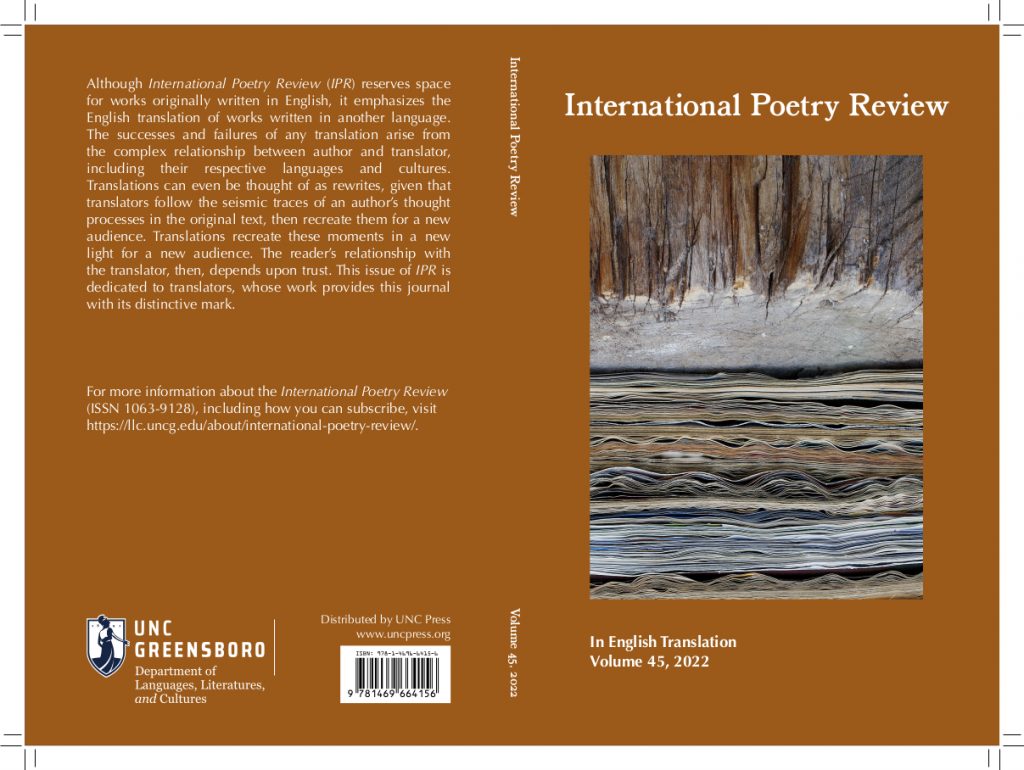
Although International Poetry Review (IPR) reserves space for works originally written in English, it emphasizes the English translation of works written in another language. The successes and failures of any translation arise from the complex relationship between author and translator, including their respective languages and cultures. Translations can even be thought of as rewrites, given that translators follow the seismic traces of an author’s thought processes in the original text, then recreate them for a new audience. Translations recreate these moments in a new light for a new audience. The reader’s relationship with the translator, then, depends upon trust. This issue of IPR is dedicated to translators, whose work provides this journal with its distinctive mark.
Cover image © Chema Castelló / HereSea (detail) Papel Mojado Series, 2013
International Poetry Review 44.2021:
Angles, Perspectives, Stories

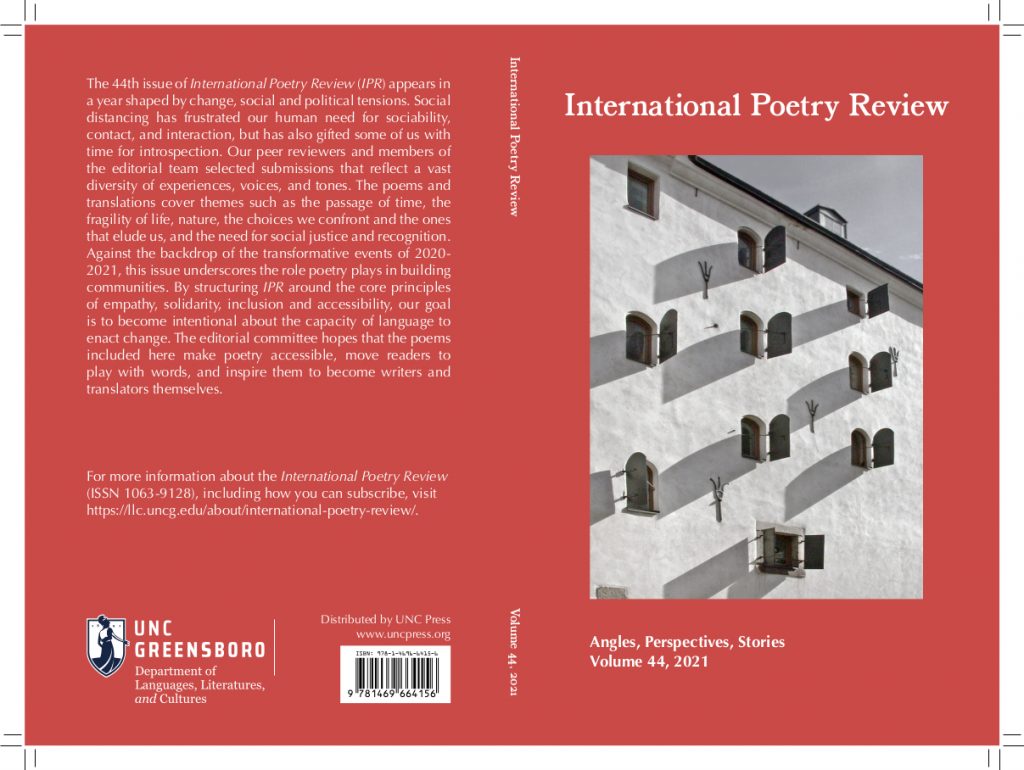
The 44th issue of International Poetry Review (IPR) appears in a year shaped by change, social and political tensions. Against the backdrop of the transformative events of 2020-2021, this issue underscores the role poetry plays in building communities. By structuring IPR around the core principles of empathy, solidarity, inclusion and accessibility, our goal is to become intentional about the capacity of language to enact change. The editorial committee hopes that the poems included here make poetry accessible, move readers to play with words, and inspire them to become writers and translators themselves.
The Latin-American Poetry Issue 43.2020:
Protest and Revolt
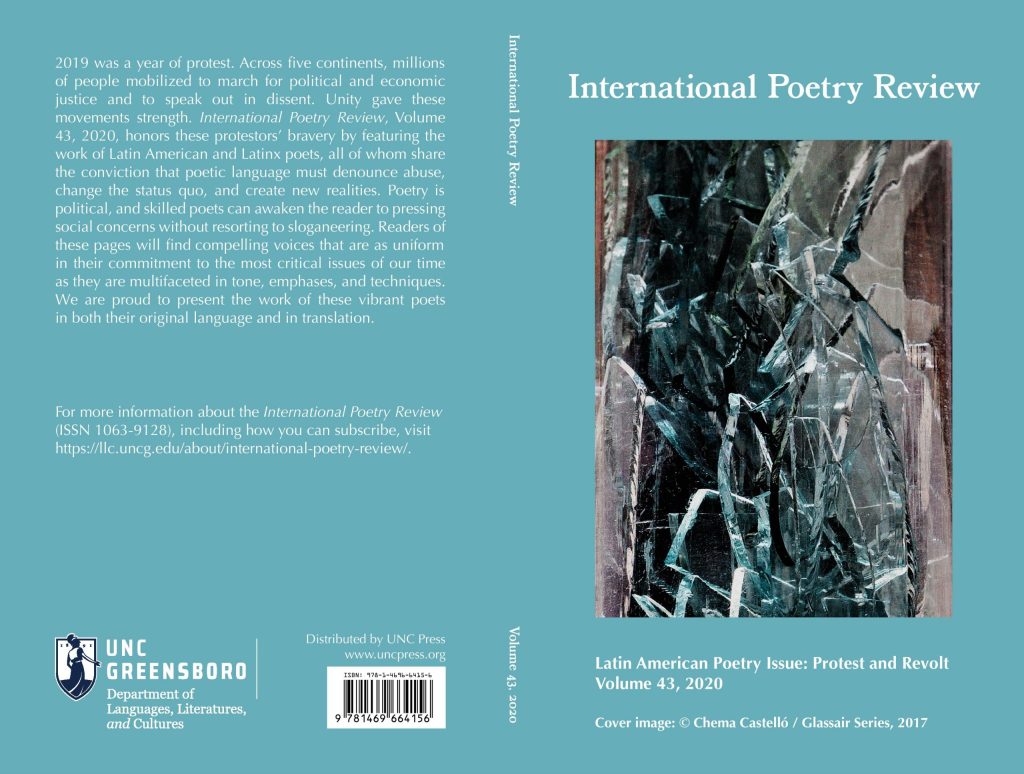
2019 was a year of protest. Across five continents, millions of people mobilized to march for political and economic justice and to speak out in dissent. International Poetry Review 43.2020 honors these protestors’ bravery by featuring the work of Latin American and Latinx poets, all of whom share the conviction that poetic language must denounce abuse, change the status quo, and create new realities. Poetry is political, and skilled poets can awaken the reader to pressing social concerns without resorting to sloganeering. Readers of these pages will find compelling voices that are as uniform in their commitment to the most critical issues of our time as they are multifaceted in tone, emphases and techniques. We are proud to present the work of these vibrant poets both in their original language and in translation.
Editorial Team
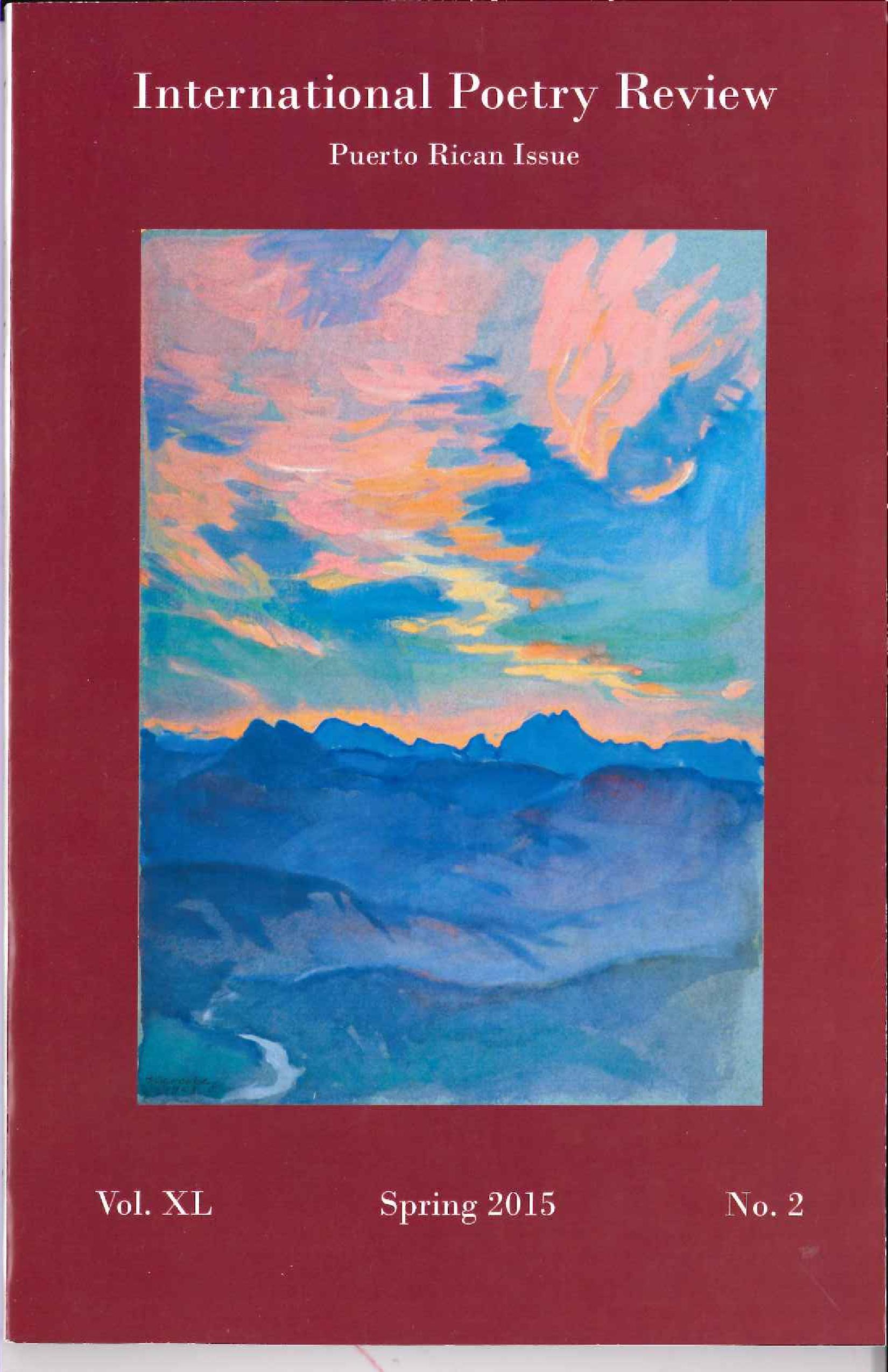
Over the years, faculty in the Department of Languages, Literatures, and Cultures (formerly the Departments of Romance Languages and of German, Russian, and Japanese) have served as editors of the journal: Evalyn Gill, Raymond Tynes, Mark Smith Soto, Kathleen Mcfie, and Ana Hontanilla to name a few. Many faculty members have also served on the editorial board, including Roberto Campo, David Fein, Veronica Grossi, Ramiro Lagos and Carmen Sotomayor.
During my tenure as editor, the editorial board changed with each issue, as every volume was sustained by the work of many collaborators. These included co-editor Rose Facchini, translator-editors Ali Askerov, Sarah Booker, Dario Borim, Michelle Chayne, Andre Holzman, Jeff Jones, Sam Krieg, Tia Nutters, Mark Smith Soto, Meikin Sun, and Chiaki Takagi; poetry readers Mercer Bufter, Peter Dola, Veronica Grossi, Sarah Krive, and Victor Pambuccian; consulting editor Luis Correa-Díaz; and guest editors Suja Suwafta, Mercer Bufter, and Alan Smith, from UNCG and other national and international institutions.
Special thanks to Ignacio López, who generously donated his time and expertise in the typesetting of Volume 44 (2021). I would also like to thank Keyla Márquez, Leyra Márquez, and Umani Tewari, who assisted with the typesetting of subsequent volumes; Chema Castelló for his photographs; Joshua Lunsford for maintaining the website; and Danielle Parmesano for managing the mailing of issues and tracking subscriptions and payments. Without their behind-the-scenes support, International Poetry Review would not have been possible.
Finally, thanks to all those who actively supported the publication of each issue by contributing their time, care, and expertise, as well as to those who quietly sustained the journal’s work over the years.
International Poetry Review counts among its lifelong supporters the following poetry lovers:
Louis Bourne
Phil Cohen
Fred and Susan Chappell
Bernhard Frank
Alice Hill
Ruthie Katzenstein
Stevenson Lupton, Jr.
Karol Neufeld
David Schenck, Ph.D.
Maria H. Schilke
Dr. Alan E. Smith
David and Zita Smith
Mrs. Betty Watson